
A BLAST FROM THE PAST
A review of Strange Days, Doors tribute band

Jason Tosta as “Jim Morrison”
Forrest Penner as “Robby Krieger”
Alexis Angel as “Ray Manzarek”
Dave Madden as “John Densmore”
https://www.strangedaystribute.com/
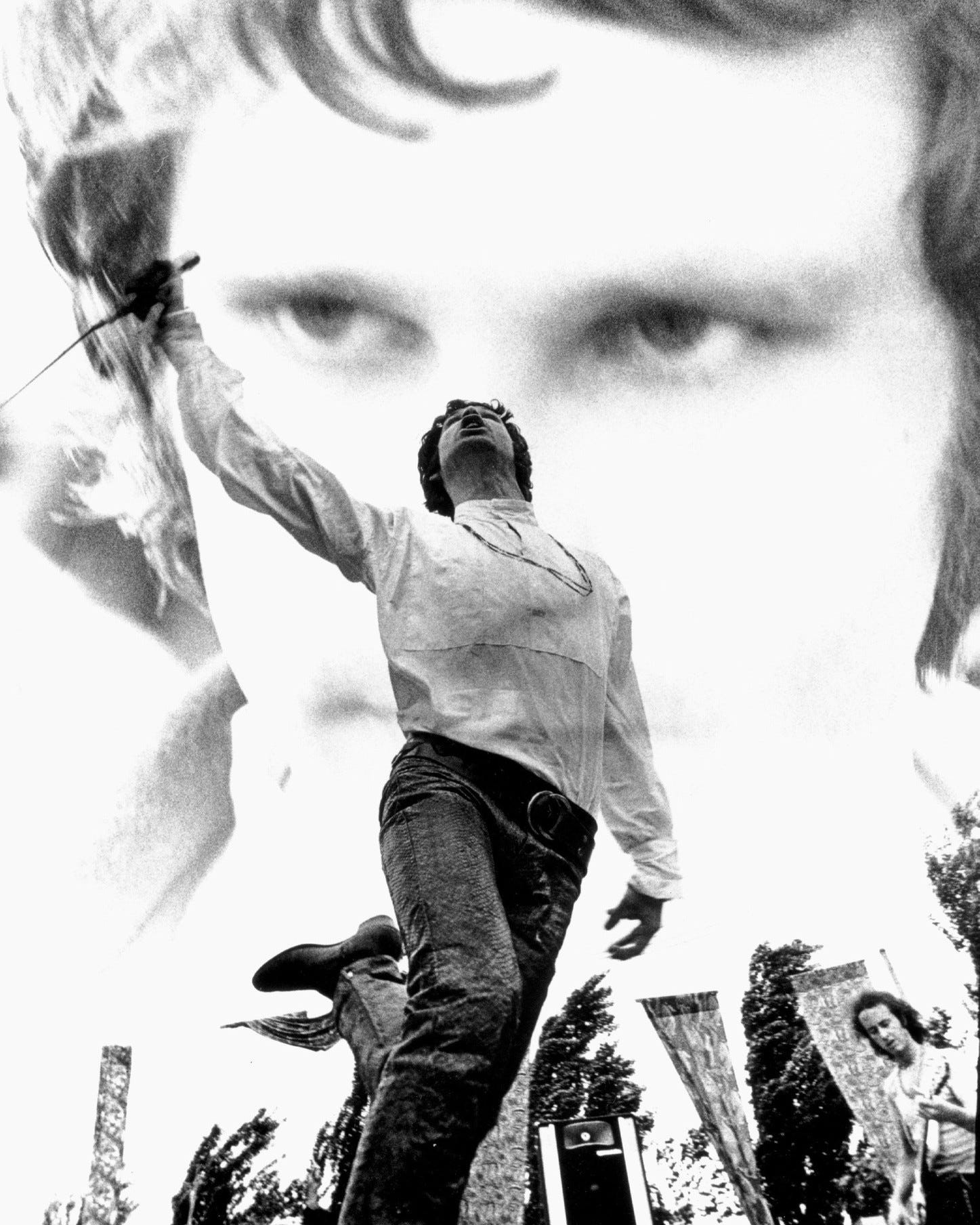
Jim Morrison was larger than life
Ever since the likes of Ken Kesey, Hunter S. Thompson and Tom Wolfe invented New Journalism by including themselves in their stories, the best writing is personal, and so it is with this review of Strange Days, The Doors tribute band, who performed at The Chapel in San Francisco on Friday night. It was my birthday, and my friend insisted we go to see the show. I was hesitant. The last couple of tribute bands I saw, including another Doors tribute around 2013, had disappointed. These kinds of shows usually draw grey-haired women in their 60s and 70s. I had hopes for something better but was talked into it. Wow, was it worth it.
Allow me to describe my relationship with Jim Morrison and The Doors. In high school I knew there was a band called The Doors who played a song called “Light My Fire,” which I liked. I knew nothing more and had never heard of Jim Morrison. When I was 19 I fell in love with the band. Then I went to see Apocalypse Now. I had never heard “The End.” As soon as it began to play in a theatre with Dolby Surround Sound I recognized it to be The Doors, and as Martin Sheen’s Captain Willard says, “It really sunk the hook in me.”
At the University of Southern California my roommate said of me, “You are a conundrum, a complete mystery. You are a Christian, a Reagan conservative, who has equal interest in General George Patton and Jim Morrison.” Indeed, I was then and am now a dichotomy.
During this time I was listening to Los Angeles FM rock station KMET when they announced a press conference in which Jim Morrison, reported to have died in Paris in 1971, was actually alive, having lived in Africa, “with simple people, and by simple I don’t mean unintelligent.” Finally at the end it was announced as an April Fool’s joke, but it got me good.
At USC I organized a small but enthusiastic group of Doors fanatics. First I went to see a Doors tribute band called Wild Child at an off-campus club. I was sitting at the bar with my buddy Mickey Meister when the lead singer, an absolute dead ringer for Jim Morrison, dressed to the nines in Morrisonian regalia, strode into the place with all of Jim’s swagger, and sat down next to us. He was in full character, and we played along. Mick and I knew so much about Morrison that we were able to carry on a half-hour conversation without anybody breaking the spell. “Morrison” and his band put on a masterful show that evening.
I took a class in the USC School of Cinematic Arts, and we studied Apocalypse Now down to the nub, with a deep dive on The Doors’ role in the film. I read No One Here Gets Out Alive by Danny Sugarman and Jerry Hopkins, committing it to memory. I led my intrepid group on several “Morrison pub crawls,” which started out by checking into the Alta Cienega Motel (which featured a copy of the cover of No One Here Gets Out Alive, a strange thing to show people checking into a creepy old motel) where Jim had lived periodically, then moving from Barney’s Beanery to the Strip, bar hopping from the Whisky to Gazzari’s to the Rainbow. Jim was dead about a decade, but there was just a whiff of the 1960s still in the air, certainly if you were willing to look for it, and to know it when you found it. We found it, baby.
The Doors increased in popularity after Apocalypse Now, and I started singing “Break on Through” and “L.A. Woman” at karaoke bars. Then Eleanor Coppola’s Hearts of Darkness came out, and I became fascinated with Apocalypse Now screenwriter John Milius, who invented the film at USC some 14 years before I was there. I sensed that I was, again quoting Willard, “close . . . real close,” that I had lived near fascinating figures of history at USC, and on the Sunset Strip. I was drawn to it, “But I really didn’t know what I’d do when I found him.”
Milius blew me away when he said that while at the USC film school he asked many veterans returning from Vietnam what music they listened to over there. Most said, “The Doors.” When Milius told the surviving members, Ray Manzarek, Robby Krieger and John Densmore this, “They were horrified that soldiers heading off to do violence with the VC were listening to their music.”
Milius described the film as, “America’s first rock ’n’ roll war, where the culture of Los Angeles, California - sex, drugs, rock ’n’ roll, Playboy Playmates, surfing - met this ancient Oriental mysticism that had withstood invasion for a thousand years.”
Has anybody ever had a greater beauty hook for a movie than that?
Milius always wrote Doors music into all of his versions of the screenplay, roughly between 1968 and 1975, but he favored “Light My Fire,” particularly in a jingoistic final scene, a “fire fight” between Colonel Walter Kurtz and Captain Willard with the Viet Cong, but director Francis Ford Coppola did not like that ending. Coppola had heard the band perform “The End,” which was made into legend at The Whisky in 1966, and chose that as the movie’s utterly and absolutely perfect theme, both at the beginning and at . . . the end.
In 1991 Oliver Stone, who had been one of those soldiers listening to The Doors in the ‘Nam, made The Doors. Many panned it, including most of the band, but I loved it anyway. A few years later Forrest Gump made ample use of the band’s music in its Vietnam scenes. The Doors can be found in many, many films, which makes a certain amount of sense since they started off studying movies.
In 1995 I saw another Doors tribute band. The crowd was young and included hot girls. Morrison was still sexy, having died “with a good-looking corpse” like James Dean and Marilyn Monroe. A couple years later I saw the same band play in Redondo Beach, and again the beautiful beach girls of the South Bay were out in force, but when I saw another Doors band around 2013, they were tired, the music was slow, the crowd middle-aged and unenthusiastic. So it was when my friend insisted we go to see Strange Days, I was not so hot to trot.
But I had written Coppola’s Monster Film: The Making of Apocalypse Now. I included three or four chapters on the significant role of Jim Morrison and The Doors on that film. This included a dissection of Morrison’s and Manzarek’s time in the UCLA film school, their relationship with fellow Bruin Coppola, and John Milius’s fascination with their songs starting out during his years at USC.
I taught several courses at USC’s Annenberg School of Communications-Journalism and was asked to teach a course based on my Apocalypse Now book for the Cinematic Arts school. The class included one of the film school’s professors quizzing me on my extensive analysis of Morrison and The Doors on the movie. Questions from the audience were heavily slanted with interest in the band. Morrison and his little tribe of Bruins were still hot, and of great interest cross-town with the Trojans.
Strange Days
Located naturally in Los Angeles, Strange Days has been around a decade or so, give or take a few years. “Jim Morrison” is played by Jason Tosta, whose hair and clothing style perfectly mimics Morrison circa 1968. But more than that, he sounds just like Morrison, and his actions cavorting on stage duplicate the great artist to a tee. He has studied his subject and mastered all of Morrison’s asides, the extra things he said and did while singing during live concerts. Strange Days does not imitate Doors songs from studio albums produced by Paul Rothchild, but from live performances, many of which can be found on YouTube, or some albums such as a live one in which Morrison exhorts, “Hey Philadelphia! Do you feel alright?”
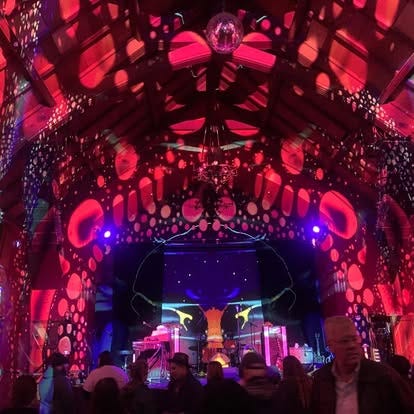
The psychedelic scene at The Chapel had the audience back in the ‘60s
Tosta is older but from a distance looks youthful. He shouts, “Perty good, perty good, perty neat, perty neat,” just like Jim, or screams, “An ancient lunatic reigns in the trees of the night. Ha ha ha ha.”
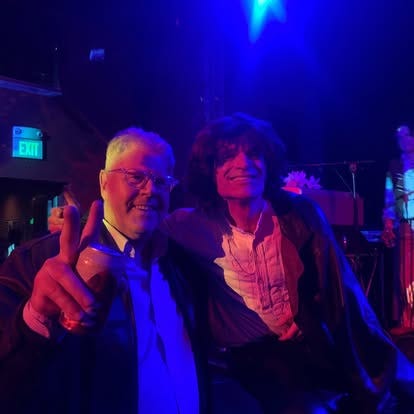
Travers, flaunting the USC-UCLA rivalry with a victory sign, with Jason Tosta as “Jim Morrison” (“We beat the Bruins 21-20 in 1967”)
He also offered that he was glad to see so many people coming out to “honor one of the greatest musical groups of all time, and that is not an opinion, but a fact!” Right on, brother. I could not have said it better myself. He is a student of his subject and his performance is nothing less than insane.
Forrest Penner, a veteran guitar artist, handles the assignment of “Robby Krieger,” one of the great, underrated guitar players in rock history, who wrote several of the band’s songs including “Light My Fire.”
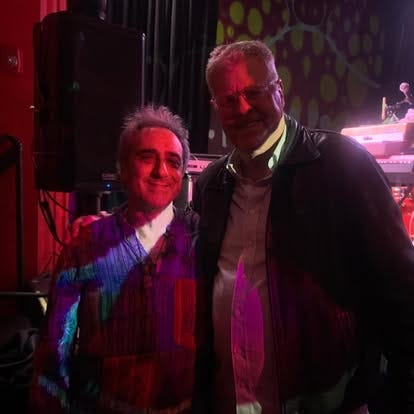
Travers with Forrest Penner, who plays guitarist Robby Krieger
Alexis Angel is a revelation as “Ray Manzarek.” With mops of long hair and a blue suit, fashioned straight out of the Mod era, he looks like a 19-year old, his head down, while he dutifully handles the keyboard. He remains as background music until those periodic outbursts of sound that marked so many Doors hits, like “Light My Fire,” “The End,” and many more.
Finally, mentioned last as “John Densmore” often was, is drummer Dave Madden, a veteran of the tribute scene since the 1980s. My God, the man is a genius back there, an integral part of a band that would slow the music down, only to bring it back with thunderous exclamation points led by Densmore’s, and his, great drumming.
The band played every single epic Doors song I could think of. At halftime people in the bathroom were shouting their enthusiasm for what they had just heard, and offering what they wanted to hear in the second half: “Twentieth Century Fox.” “I Looked at You.” “Soul Kitchen.”
“Morison” explained that Twentieth Century Fox was about college girls, who were “fashionably lean, and fashionably late.” The nostalgia was so thick at that point it could be cut with a knife. Morrison attended UCLA when Playboy model Barbi Benton strode on campus, a place that was a veritable junior varsity for Hugh Hefner’s magazine, his famed mansion located less than a mile from the school up Sunset Boulevard. What times those must have been.
The audience, a packed house ranging from aging rockers to 20-something musicians, including many pretty girls, was in rapture. Strange Days finished with “L.A. Woman,” which had the place singing, “Cops in cars, the topless bars, never seen a woman . . . so alone,” and when “Morrison” got to, “The hills are filled with fire,” it was a poignant reminder of the recent L.A. inferno.
After leaving the stage they of course returned for the ultimate encore, “The End.” While this song made The Doors famous as a live rendition, getting them kicked out of a Mickey Cohen-owned club when Morrison blasphemed about killing his father and banging his mother, it is a heavy lift live because of the studio additions, but Angel as “Manzarek” pulls it off, while Madden’s “Krieger” captured every nuance of the mysterious song, complete with sitar sounds. Originally a song about unrequited love, it evolved into a paen to death, but Tosta’s “Morrison” did not get somber or crazed as in Jim’s infamous 1969 Miami exposure of his genitalia. He hid his face as Jim did while mournfully singing, “He took a face from the ancient galley, and he walked on down the hall yeaaaaah.” When he gets to Jim’s graphic exhortation about having sex with his mother, Tosta hid the true words in a typical Morrison primal shout.
That was fine, nobody wanted to see the Miami fiasco and had not signed up for Oedipus Rex. A mention of Ed Sullivan resulted in several of the crowd shouting, “You’ll never play Sullivan again.” The audience played along and indeed two smoking hot blondes stood right on stage. I cornered one and asked her, “Are you auditioning for the role of Mrs. Pamela Courson Morrison?”
“I don’t know what you’re talking about,” she replied.
I explained that she looked just like Jim’s common law wife, and was wearing 1960s “granny glasses” just like those Pamela used to sport.
The band was happy to sign autographs and take selfies with fans, and they enjoyed my remarks which included, “Not bad for a bunch of UCLA Bruins,” or “Pretty good for a bunch of guys who weren’t talking to each other that day.” True Doors aficionados know all of these tidbits.
I explained I wrote a book about Apocalypse Now and they were genuinely interested in my insights into the band’s musical influence on the film and the war in general.
All I can say is, “Thank you” to my friend who insisted we go as a birthday present, and provided a much-needed designated driver.
Here I am, all these years later, and my fascination with these guys, their era, and the fabulous city of Los Angeles, once as Morrison’s favorite Aldous Huxley wrote was a modern day “Venice renaissance city” but is no more; well, Strange Days brought it all back to life “one more time.” Once kicked out of The Whisky, their tribute namesakes will be welcomed back to The Chapel any time.
Steven Travers is a former screenwriter who has authored over 30 books including Coppola’s Monster Film: The Making of Apocalypse Now. He is a USC graduate and attorney with a Ph.D who taught at USC and attended the UCLA Writers’ Program. He played professional baseball, served in the Army JAG corps in D.C., was in investment banking on Wall Street, worked in politics, lived in Europe, and was a sports agent before finding his calling as a writer. He has written for the San Francisco Examiner, L.A. Times, StreetZebra, Gentry magazine, Newsmax, Substack and MichaelSavage.com. He lives in California and has one daughter, Elizabeth. He can be reached at USCSTEVE1@aol.com or on Twitter @STWRITES.